Made in America
By
Virta Ventures
ON
August 27, 2026
The week America turned 250, on any stretch of sunny, windy Texas afternoon, wind and solar were quietly supplying a plurality of the state's electricity, on a grid with no mandate telling it to do so. Three weeks later, on July 22, that same grid hit an all-time record of just over 91,000 megawatts of demand, driven by a heat dome so severe it had already forced Washington and Philadelphia to cancel their own Fourth of July parades. Through most of that same month, smoke from more than 3,500 wildfires burning across Canada, on top of nearly 40,000 fires that had already scorched over 3.6 million acres across the American West, turned the skylines of New York, Toronto, and Duluth orange.
Hold both of those facts in your head at once and you get the actual shape of this moment. The country built a grid resilient and cheap enough to absorb a heat wave that broke records. The same heat wave was severe enough to shut down the nation's own 250th birthday parade. Extraordinary capability and real urgency, running at the same time, in the same month. That is America right now, in miniature: immense progress, arriving exactly as fast as the problem does, and not one day faster. The honest lesson isn't pride and it isn't panic. It's that we have to move quicker, and do more of it, than the last 250 years might tempt us to assume.
It would be easy to spend a piece like this cataloguing what feels broken: institutions losing trust, discourse losing patience, cynicism turning into a kind of default setting. All of that gets noticed constantly, and noticing it doesn't build anything. I remain genuinely optimistic about what does: technology, paired with capital and policy smart enough to know the difference between helping and getting in the way, is still the most reliable combination humanity has ever found for solving problems at real scale. It has a second, less obvious effect too. Built well, technology doesn't just solve problems, it brings people back together around something concrete. A cheaper solar panel or a faster-permitted reactor is useful to everyone who needs power, full stop, regardless of whatever else divides them. That belief, more than any single statistic in this piece, is what the rest of it is actually about.
Five Forces, One Decade
None of what follows is happening in isolation, and that convergence is exactly what makes this decade different from the last time American industrial policy tried to matter. The grid is straining under new demand in the same years that capital is flooding back into hardware, in the same years that Washington and Silicon Valley are ending a decade-long estrangement, in the same years that the country's supply chains are being rebuilt from scratch. Any one of these forces on its own would be a notable trend. Layered together, they add up to a rare alignment of incentive, capital, and urgency, all pointing in the same direction at the same time.
Energy Abundance: Start with power, because nearly everything else here depends on it. The near-term driver is AI: U.S. data center electricity demand is on pace to roughly double in two years, from about 31 gigawatts in 2025 to somewhere near 66 by 2027. The longer-term driver, arriving whether or not AI keeps its current pace, is electrification: transportation, heating, and heavy industry are all in the early stages of a multi-decade shift off combustion and onto the grid, a shift we believe will require more than $21 trillion of investment in American electricity infrastructure before it's done.
Supply Chains Coming Home: The supply chains built for a more cooperative world are being rebuilt for a more fractured one. The Reshoring Initiative, which has tracked this since 2010, counted 287,000 U.S. manufacturing and foreign-direct-investment jobs announced in 2023 alone, the second-highest year on record, part of more than 2 million announced since it started counting, still working against a goods trade deficit north of a trillion dollars a year. Whatever one thinks of the politics behind it, the direction isn't ambiguous: more of what the country uses, it now intends to make.
Silicon Valley Meets the Pentagon: Silicon Valley and the Pentagon are back in business together, a partnership that would have seemed unlikely a decade ago. Defense technology startups raised more than $14.6 billion in the first half of 2026 alone, already ahead of all of 2025's total, and the category's largest company, Anduril, closed a $5 billion round in May at a $61 billion valuation, roughly double what it was worth eleven months earlier. A category venture capital treated as nearly uninvestable a decade ago is now one of its most competitive. While Virta is not investing in military technology (though occasionally in dual use), we believe that this trend is a huge tailwind for all the industries that we do focus on.
Export Imbalance: There's an imbalance worth naming honestly. Over the last two decades, America's most valuable export was software: the country runs a services trade surplus of roughly $300 billion a year, most of it delivered digitally, even as its goods trade runs a deficit closer to a trillion and a half. China took the opposite path and now leads the world in the physical version of the same ambition. It overtook Japan as the world's largest vehicle exporter in 2025, shipping more than 7 million vehicles, with electric vehicle exports alone doubling to a record 2.5 million units. The U.S. writes the software. China ships the hardware. That imbalance isn't a law of nature, and closing it is one of the biggest openings in this entire piece.
Capital Finds Its Way: Capital is already moving, and it's the most encouraging force of the five. Global deep tech investment reached $177 billion in 2025, up 82% year over year, and now accounts for roughly a fifth of all venture capital deployed worldwide, a share that was closer to a tenth a decade ago. One in four venture-backed unicorns minted so far in 2026 came out of robotics, defense, and aerospace alone. Entrepreneurs and the capital behind them have already started answering the question this piece is asking. The rest of this is about where, specifically, we think that answer needs to go next.
The Opportunity in Front of Us
We believe the United States has a genuine chance to regain a leadership position in exporting technology for good: technology that makes the people, businesses, and communities that buy it measurably better off. That opportunity isn't really about large language models or the next chatbot. Chasing that alone would just extend the pattern of the last two decades, a country that exports code and imports steel.
The bigger opportunity is exporting real things. Clean, firm power generation. Electric vehicles and the infrastructure that supports them. Better, cheaper ways to extract the minerals a modern economy actually runs on, without opening a new mine for every ounce. None of that requires sacrificing quality or cost to get there, particularly not now: automation and AI make it realistic, for the first time in a generation, to build high-quality, low-cost, clean products domestically and sell them to the rest of the world on their merits. We think exported capability that is useful, wanted, and paid for willingly builds more durable global influence than another round of tariffs or another arms sale ever could. It's harder to resent a country for selling you something that genuinely makes your life better.
Where We're Putting That Belief to Work
Our own focus sits inside four categories where we think this opportunity is most concrete: energy, mobility, the built environment, and industrials, spanning software all the way through hardware and fully verticalized business models.
In energy, Everstar is compressing nuclear licensing from a years-long paperwork exercise into something closer to a normal engineering timeline, essential groundwork if the U.S. is going to hit its own 400-gigawatt nuclear target by 2050. Project Omega is rebuilding the back half of the nuclear fuel cycle, turning decades of spent fuel the industry has always treated as pure liability into new fuel and critical materials. NMT is doing for geothermal exploration what seismic imaging once did for oil and gas, turning site selection from expensive guesswork into a data problem. And Tyba is the layer underneath all of it that makes the economics work in practice, an AI-driven modeling and trading platform that helps developers and operators of energy storage assets capture the value sitting inside a more volatile, more renewable grid.
In mobility, Plug is rebuilding the market for used electric vehicles the way Carvana rebuilt the market for used gas ones, an AI-native platform connecting dealers and fleet operators so an aging EV fleet doesn't become a graveyard of stranded batteries. 8Fleet is building the operational infrastructure layer that autonomous vehicle fleets need to stay charged, serviced, and dispatch-ready around the clock, the same kind of centralized backbone data centers provide for AI, this time for physical fleets instead of compute.
In the built environment, Haven's structural panel system gets a home under roof in as little as two to five days with a four-person crew, cutting hundreds of hours of on-site labor in exactly the fast-growing parts of the country where skilled trades are hardest to find. Lumina is doing the same thing to heavy equipment, building the construction industry's first fully autonomous, all-electric bulldozer, a bet that electric and autonomous can simply outperform diesel and manual rather than asking anyone to pay a premium to go green. And Actual gives developers and asset owners the capital planning software to underwrite all of this new resilience-focused building with real numbers instead of guesswork.
In industrials, Fast Metals has a patented process for pulling critical minerals, titanium, gallium, rare earths, out of red mud, the toxic waste byproduct sitting in more than four billion tonnes of stockpiles at alumina refineries worldwide, without opening a single new mine. And Arinna is proving that the same power constraint driving all of this on Earth shows up in orbit too, building ultrathin solar cells for satellites and future space infrastructure that are roughly a third more efficient than what's flying today.
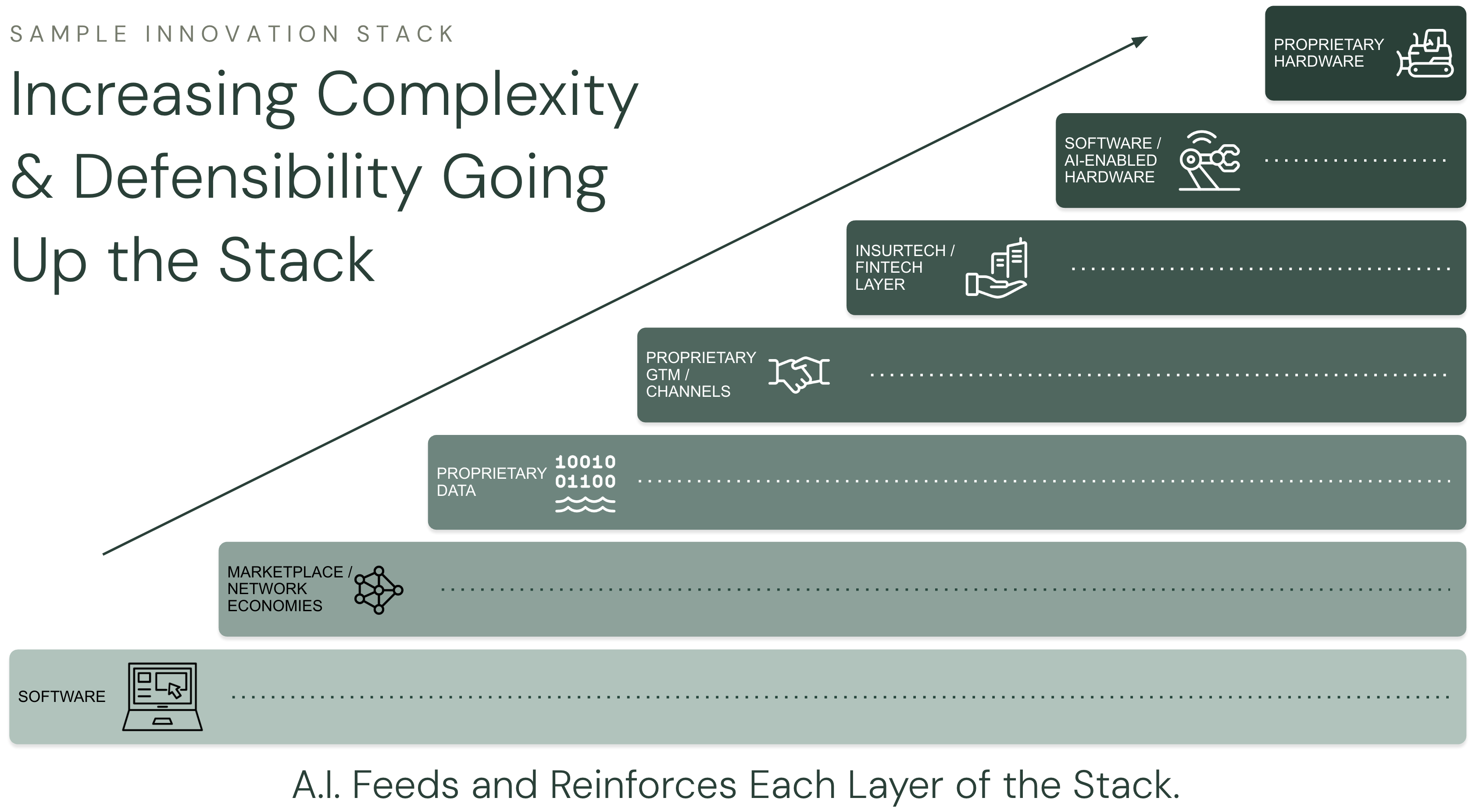
Software to hardware, bits to atoms: that is the range we're trying to cover, because we think the companies that win this decade will be the ones that master both.
The Founders We're Looking For
We back technologies that can have that kind of global impact, and founders who think about their ambition in those terms from day one. If that rings true, we want to talk to you.